Thursday, February 16, 2012

Around the World: Jaipur

February 16, 1992

Claire and I set out after breakfast to explore the interesting sights around Jaipur, also known as the "pink city".  Many of the buildings within the old walled city of Jaipur are constructed from sandstone, giving the structure a distinctive pink hue. One of the most famous buildings is the Hawa Mahal, or "Palace of the Winds".

It was originally built so that ladies of the royal house could watch the day to day events of the city without being seen from the street. When Queen Victoria and Prince Albert visited the city in 1876, the city was given a refreshing coat of pink to welcome the royal couple.


Hawa Mahal (Palace of the Winds)

Not far from the Palace of the Winds is the enormous City Palace.  Construction started in the early 1700's and additions continue to be added.  Currently, the grounds of City Palace include several palaces, pavilions, gardens and temples.  The pavilion on top of the Peacock Gate entrance offers magnificent views of the city and the surrounding hills.


City Palace


Next to the entrance to the City Palace is the Jantar Mantar Observatory.  The observatory contains fourteen astronomical instruments built by Jai Singh, the founder of Jaipur for which the city is named.  Inspired by his passion for astronomy, Jai Singh started construction on the observatory after sending scholars abroad to study at foreign observatories.  Each structure has a specific purpose, whether it's measuring the position of the stars, the declination of planets or calculating eclipses.  The sundial's enormous gnomon casts a shadow that moves 1mm per second and is accurate within 2 seconds in calculating Jaipur local time. That's amazing in itself, and especially in a country where the majority of people speak a language that has the same word for tomorrow and yesterday.


 Jantar Mantar translates literally as "calculating instrument"

Jai Singh used his knowledge of and fascination with astronomy in his plan to lay out the city of Jaipur, combined with the principles of "Shilpa-Shastra", an ancient Hindu guide to art and architecture.  The result is a geometric marvel of city planning, where wide avenues running East-West are regularly intersected by streets that travel North-South. 

Broad, straight streets are great for strolling along while browsing the shop windows, however, Claire and I quickly discovered that some Indian men find it appropriate to sample what they shouldn't be touching.  My rear is certainly getting well inspected.

The first "touch and go" came from a crafty individual who was wise enough not to stick around.  The second guy, however, left his hand unattended long enough for me to grab it.  Bending his wrist back, I shoved him into an empty space among the mob of people traveling the opposite way.  The third guy was just a victim of bad order and he discovered what a full body hip check feels like as he toppled over the metal rail that separates the sidewalk from the road. 


Typical Jaipur traffic.
Photo by Georgia Popplewell

The traffic in Jaipur is the most interesting I've seen in India yet.  Buses, rickshaws, cars, bicycles, and elephants are all perfectly acceptable modes of transportation.  My favourite was the camel-drawn carriage moving along the street at a leisurely pace.  The driver, who really is more of an unwilling passenger, is trying what he can to speed the camel up and having absolutely no success.  Using this sort of vehicle, it is important to understand that the camel goes where it wants, when it wants to and it knows there ain't a dang thing anybody gonna do about it.


Photo by Lee Harrison


A shop in the market had a display of gorgeous marble boxes.  I would have bought one, but the shopkeeper wouldn't budge from his asking price of 900 Rs.  That's $36 and a lot of money to spend on a trinket in India. When I walked out of the store, I came face to face with a bull with very large horns.  It took a step towards me and I backed up into a narrow alley.  It took another step toward me and when I saw an opportunity, I leaped past its head and out of the alley.  Once I found myself behind the bull, Claire and I just kept going. 


Stray cows out for a stroll.
Photo by Manfred Leiter
On the way back to the hostel, we stumble upon a "beer store", which is three guys sitting behind a large cooler under a sort of carport-like shanty.  Claire and I ask if they have beer.  The three men bobble their heads and say a few humorous things to each other in Hindi.  One of them opens the freezer and pulls out a large bottle of what we think could quite possibly be beer.  On the label is a drawing of a man's face that bears a striking resemblance to John Lennon.  We ask for one bottle each and head back to the hotel to sample our liquid treasure.

For the record, I won't be buying any more beer while I'm in India.

• ¤ •

"The more I see the less I know for sure."
~John Lennon

Wednesday, February 15, 2012

Around the World: Bar Hoping in Jaipur

February 15, 1992


The early afternoon train journey from Agra to Jaipur is expected to be around four hours.  As I am walking through the station toward the platform, I hear a familiar voice.

"Can you spare 5 rupees?"  It's the same drug-dazed Westerner I saw in Varanasi, clad in the same bright green, yellow and red clothing.  Is he following me?

On the train, I meet three British guys, one of whom entertains everyone with tales of trying to cause the demise of Bluey, his sister's prized budgie. Except for the sister, the bird and members of the household share a mutual detest of each other.  His father had read that a sudden shock would stop the bird's heart.  Ever since, father and son take every opportunity to covertly frighten the bird into death, so far unsuccessfully.

The Evergreen hotel is 120 Rs for a room with unlimited cold water.  Hot water is available for 10 Rs per bucket.  The war between soapy water and the constant cloud of airborne dust makes showering a pointless activity.  I seem to always be the same shade of grime, whether I'm fresh from the bathroom or returning from a day spent outside.

The hotel has a large covered outdoor area to enjoy a breeze while eating something from the hotel's restaurant.  It's now early evening and as I'm looking up local sights in my guidebook, I meet Claire, from South Africa and also new in town.  The British guys from the train plan to investigate the bar up the road and invite us to join them for a drink.

A drink?  In India?  This, I have to see.

Sure enough, just up the road from the Evergreen is a sign that says, "Bar and Restaurant."  A little further down a winding path is another sign, this one with the same words and an arrow.  The signs remind of the Road Runner cartoons and I half expect Wile. E Coyote to greet us when we get to the entrance. We follow the "Way to Bar ->" signs into a room with bench seating.  A casually dressed employee tells us the bar is closed.  Thinking some may enjoy a drink with a meal, we follow the "Way to Restaurant ->" signs upstairs to a room that looks like it was imported from a trendy area of New York.  Waiters dressed in tuxedos, perfectly pressed white napkins and tablecloths under spotless glass and silverware. 

We order 5 beers and are told, "The bar is closed, but this can be arranged for 32 Rs."  We sit at a table and wait for our drinks, but all we eventually get is a head bobbling apology.  I think the head bobble is a sign of confusion; the more difficult the question is to answer, the more intense the head bobbling is.  Two waiters come to our table, their heads bobbling dangerously close to toppling off their shoulders.  One waiter says, "No beer," while the other communicates through charades, something about a bicycle and a kingfisher.

Hoping for a beer in India proves to be the activity of the dreamer.  Claire wants to check out the Palace of the Winds, while I would like to see the Jantar Mantar Observatory tomorrow so we have agreed to do a little sight seeing together.

• ¤ •

"Without question, the greatest invention in the history of mankind is beer. Oh, I grant you that the wheel was also a fine invention, but the wheel does not go nearly as well with pizza."
~Dave Barry

Tuesday, February 14, 2012

Around the World: Agra

February 14, 1992

The rickshaw wallah was knocking on my hotel door before sunrise, prompt as promised. He takes me to the city's most popular tourist destination before the inevitable crowds arrive.

During the time of the Moghuls in the 16th and 17th centuries, Agra was the capitol of India. Emperor Shah Jahan built the Red Fort and Jami Masjid in Delhi, and many of the palace buildings inside the Agra Fort.  He is most famous for building India's most recognizable landmark, the Taj Mahal.


The white marble changes colour depending on the time of day.

Built as a tomb for the Emperor's wife, Mumtaz Mahal, the Taj Mahal has been described as the most extravagant monument built for love.  Construction began in 1631, two years after Mumtaz died in childbirth, having produced 14 children during their 17 years of marriage.  The project took 22 years to complete, requiring 20,000 workers recruited from around India and Southeast Asia. Austin of Bordeaux from France and Italian Veroneo of Venice are credited with the Taj's ornate decorations.  The main architect, Isa Khan came from Iran.


Inside the Taj Mahal


As the grounds of the Taj Mahal fill with tourists, my rickshaw driver shares some information about another famous Agra landmark.


The Agra Fort


Construction on the Agra Fort began in 1565 with the intent to be a military structure, but by Shah Jahan's time, the fort had become a partial palace.  Inside the 2½km stretch of 20m thick walls are several structures:  towers, mosques, palaces that once served as the private residence of the current Emperor, and two halls of "public audience" where the Emperor would meet foreign dignitaries or listen to the people.  As I explore the elaborate details of the Musamman Burj, I notice I am being watched by four large vultures perched atop one of the walls.  They appear to get a little restless when I'm not moving.


Staring:  The popular pastime of India


Shah Jahan intended to build a black Taj as his tomb, but before he could begin, the Emperor was imprisoned in the Agra Fort by his son, Aurangzeb, where he remained until his death in 1666.


Shah Jahan spent the last 7 years of his life
imprisoned in the Musamman Burj...


...overlooking the final resting place of his beloved wife.


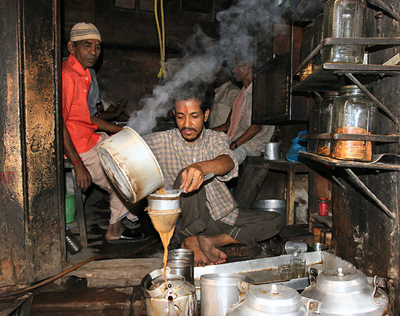
After several hours of exploring Agra's main attractions, my rickshaw wallah suggests we take a break.  He stops at a small stand in the market and offers me a traditional Indian drink, a milky, spiced tea called chai.  Milk, water, ginger, cardamom, cinnamon, cloves are boiled into an aromatic blend and infused with loose black tea.  The mixture is poured through a fine strainer and served. 


Tea wallah straining chai ready to be served.  Yum!


The driver brings me to the market where I have a chance to browse the shops selling clothing, jewelry, household items, perfume and spices.  It's a colourful display, presented in an organized form of chaos that only seems to work in India.  Every shop displays their wares in a rainbow of enticing colours and exotic smells that beg to be purchased.


Spice vendor.
Photo by Tobias Leeger


The last stop of the day includes a carpet manufacturer that wants me to import his products into North America.  The manager's hospitality ends abruptly when I refuse to invest in his scam business opportunity.  Suddenly, it's time to go. Tomorrow includes a short train journey to Jaipur, also known as the "pink city".

• ¤ •

"When love is not madness, it is not love."
~Pedro Calderon de la Barca