Saturday, February 11, 2012

Around the World: Karma in Varanasi

February 11, 1992

Feeling refreshed from a day insulated from the sensory overload of India, I decided to brave the streets of Varanasi.  Located on the west bank of the Ganges, Varanasi is the city of Shiva and a pilgrimage center for Hindus.  The river is lined with over 100 ghats, or steps leading down to the water where pilgrims take soul-cleansing soaks at the bathing ghats.  The eternal city of Varanasi is a center of learning and considered an auspicious place to die, ensuring an instant route to heaven.  It's not uncommon to see a body wrapped in white cloth being carried by stretcher to one of the two burning ghats for cremation.


Varanasi, formerly known as Benares and Kashi.


Wandering around the city, I found one of the ghats completely by accident, after trying to avoid the pestering of a drug-dazed Westerner begging for 5 rupees.  I strolled along a waterfront pathway watching men and women bathing discreetly in the river.  The pathway ended and I found myself in the old city of narrow, cobblestone streets lined by tall walls.  Lost and turned around, I eventually found my way out of the maze of alleyways, but not before dodging a few stretchers being rushed to the burning ghats and several encounters with cows that blocked my way.


Bathing ghat along the Ganges


Back out in the open of the main city, I found a shop that sold silk items.  The owner served me tea while his assistant brought out anything I showed the slightest interest in.  Eventually, I settled on a long, burgundy table runner and two white and purple pillow case covers.

Happy with my souvenirs, I head back to the hotel, and join the group enjoying tea in the garden.  Jane has met up with Fiona and the two of them will head to Nepal tomorrow and are gathering tips from Daniel and two English guys that have just returned.

The elder of the two Nepalese restaurant staff comes over and asks for our orders for dinner.  Everyone prepares to head into the restaurant when he offers to bring our meals out to us.  After some insisting, we learn that both men have left their families in Nepal.  They came to India to find work, hoping to make enough money to get settled and pay the fees required to immigrate their wives and children.  The story sounds genuine, but there are so many hard-luck tales here, it's impossible to distinguish an honest one from the countless scams.  Regardless if this is a genuine story or not, we unanimously agree that they make this sheltered garden sanctuary the haven that it is.  These two men from Nepal have been relentless in their efforts to make each of us as comfortable as possible.  While we wait for the food to arrive, we add our generosity and gratitude to a growing pile of currency on the table.

When they return with our food, one of the British guys presents each man with an envelope containing close to $80 in US cash and Indian rupee bills.  This is a little bit more than their salary for the month.  When they see the contents, both of them are shocked.  "I cannot accept this," says the older one and they both try to hand it back.


Good service deserves a good tip!

The British guy eloquently explains, "We took a poll and agreed that both of you have treated us so much better than just a hotel guest.  You have treated us like family while we are so far away from ours.  We hope this helps bring your family closer to you."

The elder man wipes his eyes and collects himself.  He explains in his language what has happened to the younger one.  They each bring their envelope held between pressed hands up to their chin and slightly bow in appreciation.  After the restaurant closes for the evening, the younger man arrives with cups of fresh tea, followed by the older man carrying a plate piled full of desserts.  We invite them to join us, but the elder man explains they are not allowed to socialize with the hotel guests.

The rest of the evening is spent enjoying the peaceful serenity of the garden.  As we are all heading in different directions tomorrow, we exchange coping strategies for traveling in India.  It is agreed that India is a fascinating place, with sights and experiences like no other, but she takes time to adjust to.  It didn't occur to me until it was mentioned that we will all go through a similar form of culture shock again, once we return home.

• ¤ •

"It is only when we silence the blaring sounds of our daily existence that we can finally hear the whispers of truth that life reveals to us, as it stands knocking on the doorsteps of our hearts."
~K.T. Jong

Friday, February 10, 2012

Around the World: Tea

February 10, 1992

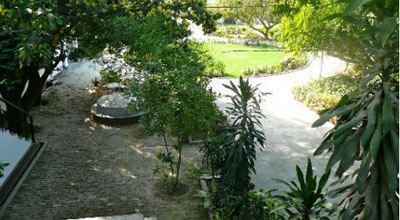
I have no intention to do anything in particular today.  I am sitting in the hotel garden, drinking endless amounts of tea and enjoying the honoured guest treatment of the kind restaurant staff.  Outside the confines of the hotel garden, I can hear the bustle of India.  Rickshaw motors and honking horns are easily drowned out by the serene sight of flowers in bloom and the sensation of grass beneath my bare feet.

My to-do list is done, having already completed the must do tasks of laundry and a shower, or more accurately, laundry in the shower.  The roads are a packed surface, not paved, so there is always fine particles of dirt hanging in the air.  A shower is refreshing to get yesterday's dirt off you, but clean only lasts until you step outside and are instantly re-dusted with a new dirt coating.

I am joined by another hotel guest from Texas who arrived late last night from Nepal.  Daniel is also enjoying a day of drinking tea in the garden.

Nepal is not far from here and easy to get to by bus.  The trip north, says Daniel, was pleasant enough and he enjoyed trekking through the Himalayan foothills of Nepal.  The trip back, however, was a little more exciting than he had hoped for. 

Shortly after crossing the Nepal-Indian border, his bus collided with a cow.  A farmer appeared, saw the state of the cow, and started beating the bus driver with a large stick.  The driver managed to escape while the farmer continued to beat on the bus, breaking several windows, including the windshield.  The passengers just hoped the farmer would take his frustrations out on the bus and leave them alone.

After about an hour of being held hostage by the bus assaulting farmer, the police finally arrive with the terrified driver.  The farmer confirms that this is the man who killed his cow.  An officer explains to the passengers that the driver is now in police custody.  The farmer will go back to his village and when they learn what happened, the entire village will be incensed.  The villagers will hunt the driver down and kill him if they find him.  The police will take the driver to jail because it's probably the only place in the state where he will be safe.  

Now, Daniel finds himself among forty other tourists, on a bus with no driver somewhere in northern, rural India, and very close to a village full of angry, homicidal farmers.  The police need to gather evidence and tell everyone to wait on the shoulder of the road.  The bus is in a frightening state.  The windows are all smashed and there's an indent on one side of the hood, followed by a long smear of blood along one side.

After a short wait, another bus arrives to continue the journey to Varanasi.  This bus is also missing a few windows, has a big dent in the hood and blood smeared down one side, but made the rest of the journey without further incident.


I take mine with a splash of therapy


Outside the confines of the hotel garden, I can hear the bustle of India.  This garden is a great insulator, a place where the bustle of India is not permitted entry.  And Daniel and I have not yet had enough tea.

Thursday, February 9, 2012

Around the World: Arriving in Varanasi

February 9, 1992


The sun is coming up.  I'm tired, but the catnaps have given me enough to stay conscious.  At one station, two men in military uniform carrying rifles board the train.  They give everyone a deliberate, inspecting glance as they slowly make their way through the car.  Their gaze and inspection stops abruptly and remains on Jane and I sitting on the floor.

Great.  What could be worse than being stared at by a pair of armed soldiers?


Photo courtesy of ImageShack


One of them looks at the benches to his right and says something to the men sitting there.  The other motions for Jane and I to approach them.  Oh, dear lord, what have we done!?  I'm too tired to panic when surprisingly, they command the seated men to move and indicate for us to sit in their place.  They sit beside each of us, as far away as possible on the aisle side of the bench. Other than some curt words to remove the men from these benches, our dutiful sentries remain silent. Relieved and grateful, I let exhaustion take me into an uneasy sleep.  

I am roused by a gentle shaking of my shoulder.  Our military escorts indicate they have to leave.  Surely, they want baksheesh for all they've done, and I won't be offended in the least if they do. As they gather their belongings, I ask the one closest to me, "What can I give you for being so kind?"

He puts his bag down on the bench, turns to face me and nods his head respectfully.

Hands together, I nod back, "Thank you."  He throws his bag onto his shoulder, picks up his gun and the two soldiers exit the train.

India is starting to show her true colours.  The interior of this coach, on the other hand, is another matter altogether.  It looks more like a compost heap.  Ripped pieces of newspaper and peanut shells are strewn in heaps on the floor.  The train remains at the station for some time, but I'm getting used to the fact that nothing in India happens on time.  The delay presents an opportunity for beggars and vendors to board the train, which I'm getting skilled at ignoring.

One man approaches Jane and I, holding a little horn and a small wicker basket, and says, "Look what I got."  I'm expecting rice or samosas.  He lifts the lid and out jumps the head of a large cobra.


Image courtesy of Pixdaus


The bars on the window are the only reason I am still on the train.  I scream out all sorts of suggestions for what he can do with his snake and he leaves, laughing.  All the other passengers on the train are laughing.  I'm not laughing.  Jane is hysterical.  One of the passengers explains that the cobra wouldn't have harmed us.  "It's just a way to get tourists to part with their money."

My heart is going to beat itself up my esophagus and out of my forehead if I stay here any longer. Jane is barely holding it together. I toss my pack on and tap Jane on the shoulder.  "C'mon," I say, picking up her pack.  Bewildered, she follows me along the platform to an empty first class car.  First class has glass windows, cushioned seats and seems to be forbidden territory for non-passengers.  It's also air-conditioned like a refrigerator.  Cold is a colossal improvement over cobras.

The train pulls out of the station and Jane and I break into hysterical laughter as we become aware of the uncontrollable, full-body tremors we are both experiencing, which took almost an hour to subside.  The train is over two hours late arriving in Varanasi.

Outside Varanasi station, Jane and I are surrounded by dozens of rickshaw-wallahs (drivers) yelling out, "Take you to my hotel for 20 Rs and 10% commission!".  Finally one shouts, "I take you anywhere you want!  10 Rs and 2% commission."

I say, "5 Rs and no commission!"  I don't know what the commission is all about, but the hotel is walking distance from the station.  I just don't know which way and hope he does.  He agrees to the price and we're off. The hotel is 88 Rs and comes with a restaurant, a mosquito net over my bed and a spacious garden.


The manager changed some money for me at a better rate than the bank.  He explained businesses will often give a better rate for cash than the bank because they get a huge tax break for holding foreign currency.  It's difficult to change traveler's cheques because they have been used in so many scams, even banks won't accept them.

During the past two days, I've had too much India and not enough sleep.  The restaurant is staffed by two wonderfully benevolent men from Nepal who suggest that tomorrow, I would enjoy my morning cup of tea in the garden.

• ¤ •

"In the blackest of nights, if you look up, you can see the stars."
~Unknown